
The Ministry of Justice has opened its consultation on the levy proposals under the new Anti-Money Laundering and Countering Financing of Terrorism (AML/CFT) National Strategy 2026-2030 (Strategy), which was recently announced.
The Strategy, which comes into effect on 1 July 2026, outlines the Government’s vision for the AML/CFT regime. The accompanying four-year work programme details how the Government intends to realise that vision. This will be supported by planned amendments to the Anti-Money Laundering and Countering Financing of Terrorism Act 2009 (AML/CFT Act). Funding will come from a combination of Government contributions and levies paid by reporting entities.
Submissions on the levy proposals are open until 5pm on Friday, 10 April 2026. The consultation document can be found here, and the Strategy and work programme can be found here.
Who needs to read it? Why?
All reporting entities – but particularly those in medium-high or high-risk sectors (as assessed by the Department of Internal Affairs’ (DIA) in its Sector Risk Assessment, the Financial Markets Authority in its Sector Risk Assessment and the 2024 National Risk Assessment) – will be required to pay the levy and should therefore review the consultation document and consider making a submission.
What does it cover?
On 13 February 2026, the Government released the Strategy and four-year work programme. According to Associate Minister McKee in her press release, the Strategy was developed in consultation with the industry and “provides clear direction and certainty – setting out the Government’s priorities and objectives so the AML/CFT system can plan ahead with confidence.”
The reforms aim to make the AML/CFT regime “truly risk-based, to cut unnecessary red tape for low-risk customers and transactions, while sharpening enforcement where it matters most.” The Strategy also confirms the move to a single AML/CFT supervisor, being the DIA (which we have previously discussed).
The work programme sets out an action plan for how the Strategy will be given effect to. This will take place over a four-year period, between 2026 and 2030.
An industry-wide levy will help to fund the Strategy and work programme, alongside Government funding. The consultation document sets out:
-
the need for levies and its connection to the AML/CFT National Strategy and work programme;
-
the cost recovery approach that is proposed to be taken;
-
the costs that need to be recovered via a levy or levies;
-
the design of the levy or levies.
The consultation document proposes that the levy will be payable only by reporting entities in medium-high or high-risk sectors, as assessed by the Sector Risk Assessments and the 2024 National Risk Assessment. According to the document, this “aligns with the cost recovery principle of equity, where beneficiaries or risk exacerbators have given rise for the need of the relevant function, power or service.” The Ministry summarises the list of high and medium-high risk reporting entities as follows:
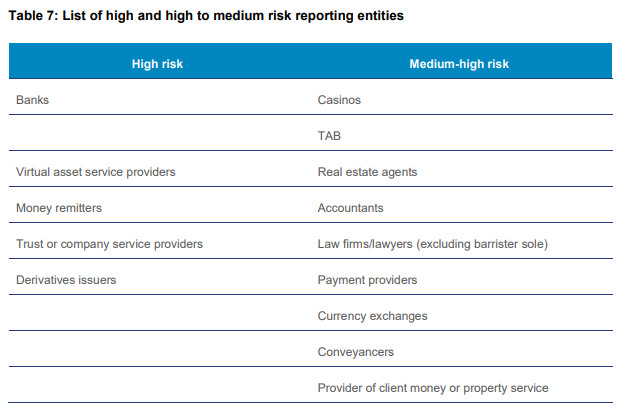
- The Ministry categorises the reporting entities into three groups for levy purposes: Banks;
- Casinos and TAB; and
- Financial institutions and DNFBPs (designated non-financial businesses and professions).
Banks
It is proposed that banks pay 85% of the total estimated costs, “for equity and efficiency reasons” and due to the risks that banks pose to the financial system. The value of each bank’s reported assets will determine its levy contribution. Banks with less than $1.5 billion in reported assets would be exempt from the levy. The estimated levy for each bank is set out in the consultation document.
The consultation document recognises that the Deposit Takers Act 2023 will remove the distinction between banks and non-bank deposit takers (NBDTs) in late 2028. While NBDTs are currently excluded from the levy, their exclusion "will be reconsidered in 2028, alongside an assessment of risks to the AML/CFT system. However, the proposed $1.5 billion threshold should exclude current NBDTs."
Casinos and TAB
Casinos and TAB are proposed to pay 9% of costs. Again, the estimated levy for each entity is set out in the consultation document. In the DIA’s view, there is sufficient level of risk in this sector to the AML/CFT system that they should pay a higher proportion of the levy than other non-banking financial institutions and DNFBPs. The levy rate will be calculated based on expenditure/player loss data provided to DIA.
Other financial institutions and DNFBPs
Other financial institutions and DNFBPs will cover around 6% of costs. The Ministry of Justice proposes three options for cost recovery (with each rate to be calculated on a per annum basis):
-
A flat levy rate for every reporting entity required to submit an annual report (except for banks, casinos and the TAB);
-
A flat levy rate for all entities in a sector, based on the number of compliance assessments a supervisor has made in that sector; or
-
Costs are apportioned to each sector based on the number of compliance assessments (as per option 2) and the individual entity levy determined on either value of transactions or estimated number of customers they have conducted customer due diligence on. This is the Ministry’s preferred option.
There is more detail on the proposed methodology for each option in the consultation document.
Our view
We recognise there will be a wide spectrum of views on the levy proposals. Some reporting entities may take the view that the levy payable should be proportionate to the size of a business, with larger players (such as banks) bearing a greater portion of the levy burden.
Others may argue that smaller reporting entities should pay a higher levy as they can pose more risk, due to less robust AML/CFT processes.
A further view is that the levy should correspond to a clear benefit being provided to the reporting entities as levy payers, rather than only broader public benefits of a strong AML/CFT system – otherwise, the levy may risk being more of a tax.
The proposal to levy only reporting entities in those sectors with high and medium-high (and not medium or low) inherent risk may mean that entities take a much greater interest in categorisation by the supervisors. It remains to be seen how this would play out in practice.
We encourage all reporting entities to carefully review the levy proposals and consider whether the Ministry’s proposed approach – and particularly the apportionment of costs between the different categories of reporting entities – is appropriate.
What next?
Submissions on the consultation are now open until 5pm on Friday, 10 April 2026. Details of how to make a submission are in the consultation document.
If you have any questions in relation to the consultation or are considering how these changes (if implemented) may affect your firm or business, please contact one of our experts.
This article was authored by Leanne Chew, a solicitor in our Financial Services team.
Key contacts
Speak with one of our experts.