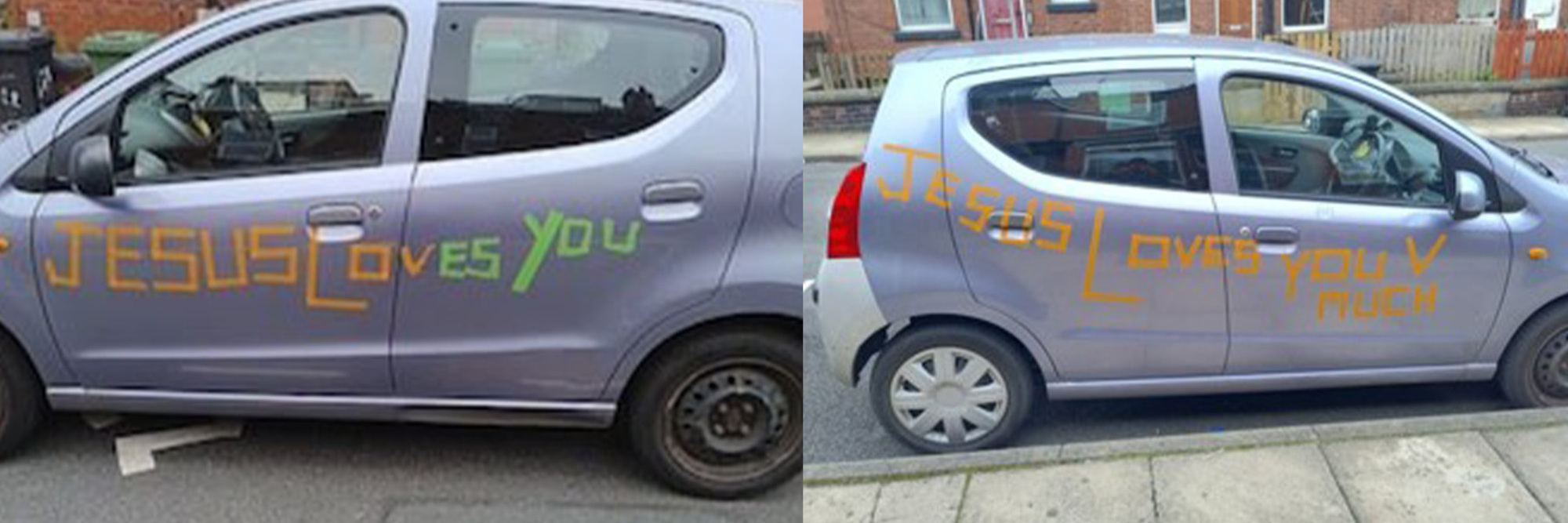
Mr Simeon Chandra of Birmingham is a committed Christian. Wishing to share his devotion, he decided to express his faith with a message on his car, a 2009 Nissan Pixo. He did this by writing “JESUS Loves you” on one side and “Jesus Loves you much” on the other, using coloured sticky tape.
Prudently, he declared this to his insurer as a ‘modification’ to his vehicle. Unfortunately, this caused a problem, because his insurer, GoSkippy, “declined the modification” and advised him that his policy would not remain in effect unless he removed the tape and provided evidence that he had done so.
“Feedback from the Underwriting Department declined the modification done on the vehicle as per stickers added on the vehicle. For the policy to continue and be insured we require the stickers to be removed from the vehicle and send a dated photograph once the stickers have been removed.” – GoSkippy
Mr Chandra objected to this and while he removed the stickers, he sought legal advice from a Christian legal centre as to whether his rights to freedom of expression and religious belief had been breached.
Similar issues had arisen in another case some years earlier when another insurer, Age UK Insurance, advised an independent Christian minister that professionally made letter stickers she had placed on her car spelling out “Christ must be Saviour” could be viewed as modifications that might invalidate her policy, when she made a claim for minor damage. In that case the insurer ultimately accepted her claim, having decided that it had not been clear enough in its request to declare all modifications.
These cases raise several issues of law relating to insurance.
May an insurer deny cover for a statement of religious belief?
Under s 21(1)(c) of the Human Rights Act 1993, religious belief is a prohibited ground of discrimination. Section 44 makes it unlawful for anyone who supplies goods, facilities, or services to the public – which expressly includes insurance facilities under s 44(2) – to refuse to provide them, or to treat a person less favourably in providing them, by reason of a prohibited ground of discrimination.
The Human Rights Review Tribunal has held that the s 44 prohibition on refusing a service is absolute and requires no comparator – a complainant need only show that the service was supplied to the public and was refused “by reason of” a prohibited ground, after which the onus shifts to the alleged discriminator to establish a statutory exception. While s 48 permits insurers to offer policies on different terms for different sexes, disabilities, or ages where the differential treatment is based on actuarial or statistical data or reputable actuarial or medical opinion, these exceptions do not extend to religious belief.
There must, however, be a genuine causative link between the prohibited ground and the refusal for liability to attach. The issue is whether cover was refused because of Mr Chandra’s expressed Christian belief, or because of something unrelated, which was genuinely about vehicle risk.
Does taping a message to your car constitute a “vehicle modification”?
“Modification” is a term insurers use frequently and define rarely. Standard motor policies typically require disclosure of “modifications” that affect performance, value, or risk, such as the addition of turbochargers, body kits, modified exhausts or lowered suspension. Some insurers view non-original wheels or even upgraded stereo systems as disclosable modifications.
A few strips of tape spelling out a gospel message is not, on any sensible reading, a modification in the sense these clauses are aimed at: it does not alter the vehicle’s mechanical performance, enhance its ‘sporty’ or performance characteristics, distract the driver, or otherwise add (in any measurable sense) to its risk of being involved in an incident that might give rise to a claim. It is a decoration, arguably comparable to a bumper sticker, “Baby on Board” sign, or an ill-advised novelty decoration. It may also be compared to commercial messages or corporate signs, which are commonly affixed to vehicles.
“Modification” clauses in New Zealand motor policies are typically drafted broadly, so there is room for an insurer to argue that they are engaged by any change to the vehicle’s external appearance from its as manufactured state. The law offers a degree of protection, however, in that under s 5 of the Insurance Law Reform Act 1977, a contract of general insurance cannot be avoided merely because a statement made in the proposal was inaccurate unless that statement was both substantially incorrect and material. “Substantially incorrect” and “material” are measured by what a prudent insurer would have considered material and relevant to the premium or the terms on which the risk would have been accepted.
It is difficult to see on what basis a prudent insurer would regard a taped message as making a statement that there are no modifications substantially incorrect and material, but there are a few possibilities.
It is possible, for instance, that some slogans or statements might increase the risk of vandalism, although Mr Chandra’s wording seems innocuous. Another possibility is that the nature of the message, being tape that was fairly roughly applied, sends a message about the owner’s general care of the vehicle. The difficulty with this is that insurers do not generally treat other aesthetic choices, such as a faded paint job or a vehicle being in a dirty and generally unloved (but not unsafe) state, as a modification or otherwise as a risk factor.
Will the Contracts of Insurance Act change any of this?
The Contracts of Insurance Act 2024, when it comes into effect, will change some of the principles discussed above.
It will not touch the discrimination analysis, which remains a Human Rights Act question. Where the Act will make a difference is in relation to disclosure and misrepresentation. It replaces the current framework, including the Insurance Law Reform Act materiality test, with a statutory duty regime distinguishing consumer and non-consumer insureds.
The key change is that consumer insureds will have a new duty to take reasonable care not to make an incorrect or misleading answer to insurers’ requests for information. Whether vehicle changes will constitute modifications will be viewed from the perspective of the insured, rather than from the perspective of what a reasonable insurer would have viewed as substantially incorrect and material. Another important change will be that where an insured fails to disclose a material modification, the insurer’s remedy will be limited to a proportionate response, such as charging an additional premium rather than declining a claim if it would not have refused cover had it known of the modification.
The Act will also extend the Fair Trading Act unfair contract terms regime to apply to insurance wordings. Practically, that means a “modification” clause that is unclear may face scrutiny if it operates to defeat reasonable consumer expectations. Insurers may need to be more transparent about what they require to be disclosed.
Conclusion
Mr Chandra’s faith was not a valid basis to refuse him cover, and his tape artwork was probably not a “modification” in any material sense. An insurer relying on reasons such as these needs to tread carefully.